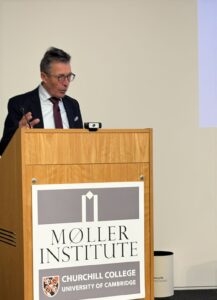
Churchill College, 10 March, Cambridge
Ladies and Gentlemen,
Distinguished guests,
Thank you for the honour of addressing you here today at Churchill College.
The name “Churchill” is somehow familiar to me.
I seem to have heard of it before.
Since childhood, I have admired Winston Churchill as a principled, persistent and passionate leader of the free world and the fight against the Nazis right from the beginning of the Second World war.
That’s why, I am honoured to have been asked to speak as we commemorate eighty years since the infamous Sinews of Peace speech.
It is a particular moment when history speaks directly to the present.
And today, it does.
Churchill asked for clarity.
He insisted on strategy.
And he warned — above all — against drift.
So let me offer an assessment.
Not a nostalgia tour.
But an assessment of what has endured, what has changed,
and what the United Kingdom, Europe — and the democratic nations of the world — must do next.
As former Secretary General of NATO and Prime Minister of Denmark, my political life was forged in the aftermath of the post–Second World War order.
An order in which the United States, together with Great Britain and democratic Europe, stood firm against autocracy.
An order built on alliances, institutions, and international law.
Against an Iron Curtain, we built a democratic curtain.
A freedom-based order — precisely the order Churchill called for.
But today, we must confront a difficult truth.
A new autocratic curtain is rising once again.
And European nations are caught between a rock and a hard place.
In a new Strongmen World.
The model that sustained our security and prosperity for decades has collapsed:
cheap energy from Russia,
cheap goods from China,
and cheap security from the United States.
Ladies and Gentlemen,
Our holiday from history is over.
Today, power is asserted — boldly, bluntly, and belligerently.
And it is difficult for me to say this,
but today it is not only our adversaries who are testing the post-war order.
Even the United States — the principal architect of that order — is at times pulling at the threads of the democratic curtain it once helped to weave.
That is the strategic landscape before us.
From that reality, I draw three lessons.
First, hard power has returned — and we must organise accordingly.
Second, the post-war alliance is under strain — and we must prevent fracture from becoming failure.
Third, we must build new democratic alliances.
First lesson: Power has returned — and it is testing us again
Churchill spoke of two “giant marauders”:
war and tyranny.
He was not being poetic.
Those marauders have not retired.
They have modernised.
War is back in Europe.
Not as a theory.
As a fact.
Tyranny has returned as a governing model.
We see autocractic regimes in Iran murder their own people to repress the desire for freedom.
We see Putin’s Russia massacre thousands in Ukraine who do not wish to live under his rule.
We see Xi Jinping build a police-state to control his people.
And here is the point Churchill would recognise immediately:
the world is again being shaped by those willing to use power.
Some use tanks.
Some use trade.
Some use technology.
And increasingly, they combine pressure, persistence, and provocation.
We are living in an age of coercion.
And coercion feeds on hesitation.
So the first lesson is simple:
we must relearn the language of vision and strategy —
not just the language of administration.
Churchill asked: what is the “over-all strategic concept”?
His answer was the safety of ordinary homes.
Ours must be the same in purpose,
even if the domains have changed:
protecting our people,
protecting our sovereignty,
protecting our democratic freedom.
Second lesson: The post-war alliance is under strain — and we must not let it splinter
Churchill did not argue that institutions alone would save us.
He argued that unity, backed by seriousness, would.
NATO remains one of the great success stories of modern history.
It deterred aggression.
It stabilised Europe.
It enabled prosperity.
And that transatlantic relationship has been the spine of European security.
But spines weaken if the supporting muscles waste away.
For decades, many Europeans assumed America would always be there —
as insurer of last resort.
But insurance only works when the insured takes responsibility.
The United States remains indispensable.
But it is also more transactional, more impatient, and less predictable.
And here lies a stark contrast:
We Europeans speak the language of principles, while others act in the language of power.
As Churchill would say:
we cannot build a temple of peace on sand.
Third lesson: Build capability and leverage — because power respects power.
Churchill’s warning was brutally practical:
courts cannot function without constables.
Russia’s war on Ukraine makes this plain.
It is a war of conquest, coercion, and cruelty.
A war designed to exhaust patience and erode resolve.
Putin will negotiate only when he believes he cannot win.
And he will stop only when escalation costs exceed the profit from aggression.
Ukraine is not just another conflict.
It is existential.
It is the most existential threat to security of Europe.
A Russian win would mean we go backwards almost a century, with Russian autocratic tentacles once again taking over Europe.
Ladies and gentlemen,
let me offer three sugestions as to how Europe must act to counter the threats to our freedom, peace and prosperity.
First: support Ukraine to win, not merely to survive.
More ammunition, air defence, long-range capabilities,
and industrial momentum that matches political intent.
Second: build European capability at speed and at scale.
We are living under a peacetime illusion.
I call for European economies to be put on a war footing.
Third: enhance and use economic power deliberately.
Trade is security.
Technology is security.
Supply chains are security.
Here, the United Kingdom matters profoundly.
Britain retains strategic seriousness.
Credible military capability.
A Nuclear deterrent.
And global partnerships Europe needs — from North America to the Indo-Pacific.
So the lesson is clear:
we must build leverage — military, industrial, and economic — to defend freedom in a world tempted by force.
Ladies and Gentlemen,
Autocracies are rising.
Imagine.
The nightmare of an authoritarian Russia..
A murderous Iran..
and an AI police state China ruling the world.
Our adversaries already align.
So it is high time Democracies align too.
Not as a bloc of hostility,
but as a coalition of free societies to protect and promote peace and prosperity.
We need a global order based on values – a freedom-based world order
Eighty years ago, Churchill warned that weakness invites danger, and that delay has a cost paid by ordinary people in their homes and streets.
He was right then. He is right now.
If democracies do not shape the future, others will.
And they will not do so in our interests—or in our image.
Today, I will make a call for an Alliance of Democracies where the core could be a Democratic 7 – D7: the EU, the UK, Canada, Australia, New Zealand, Japan and South Korea.
Others can join when they wish to defend freedom and democracy.
My message is simple:
Democracies of the world, it is time to unite.
I would prefer to be joined by the United States in our struggle for global freedom and democracy.
However, for the time being, the United States seems hesitant to exercise the leadership of such an alliance of democracies – just as the US was hesitant to join Churchill in his heroic fight against the Nazis.
In his famous “We shall fight on the beaches” speech in the House of Commons on June 4, 1940, Churchill concluded by stating: “… (we will)… carry on the struggle , until, in God’s good time, the New World, with all its power and might, steps forth to the rescue and the liberation of the old.”
Let me conclude my speech today by saying:
We will take the leadership and carry on the struggle for freedom and democracy ourselves — until America elects a government that will make America great, and the world’s democracies strong, by leading the free world – not threatening it.
I hope – yes, I believe – Prime Minister Churchill would agree.
Thank you for your attention.
For more information, please contact our Senior Director for Communications, Daniel Puglisi, at dpu@rasmussenglobal.com